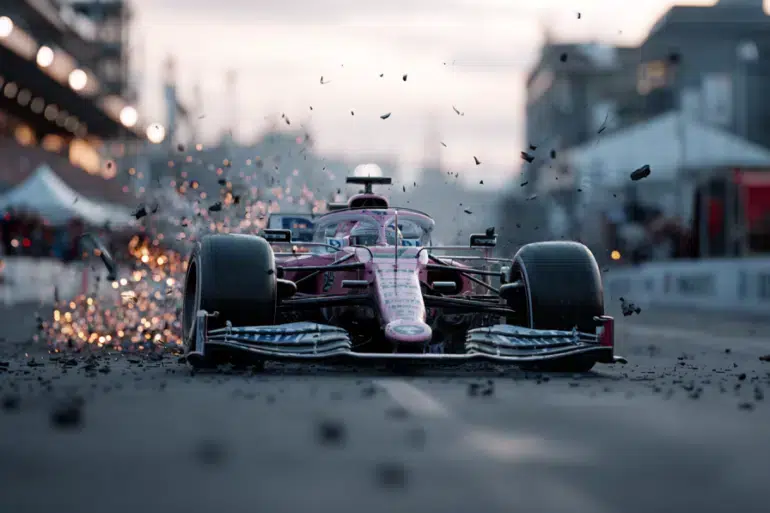


F1 could see a strategic upheaval as early as 2026 if the FIA decides to impose two mandatory pit stops per race.
For several seasons, F1 teams have won most Grand Prix races with a one-stop strategy. This has made some races predictable and limited tactical diversity. The proposal for two mandatory pit stops in F1 reignites the debate over the balance between spectacle and performance.
Two mandatory pit stops to energize F1 races
The main goal of a rule requiring two stops is to increase unpredictability and on-track excitement. With more durable Pirelli tires, limited degradation helps teams manage the race without fully pushing their rubber. This then reduces strategic variety.
More opportunities and surprises
Mario Isola, director of Pirelli Motorsport, explains that additional stops would create undercut opportunities. But it would not necessarily create more diversity. In fact, teams tend to converge on similar patterns. A soft tire for a few laps, a medium for most of the race, and a hard for longevity.

That said, some drivers, like Max Verstappen, have expressed a different view regarding two mandatory pit stops in F1. They believe, for example, that imposing two stops could generate more suspense and overtaking, compared to using an unnecessarily conservative tire.
The limits of past experience
Formula 1 has already tested the idea of two stops, notably in Monaco and at the 2023 Qatar Grand Prix. The results were mixed. In Monaco, the rule did not improve the spectacle due to circuit constraints. As for the Qatar GP, extreme conditions put the drivers to the test. These examples show that the success of such a measure heavily depends on the track and race conditions.
Simulations required for two mandatory F1 stops
Pirelli and the FIA have conducted simulations to assess the impact on strategies. The results indicate that without a compound-change requirement, teams could use various combinations. They could, for instance, choose medium-medium-medium, or soft-medium-hard.
This potentially creates more variety and tactical options. However, they will need to carefully study any change with these two mandatory stops. This will be necessary to avoid unexpected consequences on race flow.

Divided opinions within the paddock
While some see the rule as a way to make races more exciting, others remain cautious. George Russell notes that F1 can quickly become monotonous if all teams apply the same strategy. As for Mario Isola, he emphasizes the need not to ruin the existing championship. He mainly refers to the new 2026 F1 cars, which should allow more frequent overtaking thanks to better following and less dirty air issues.
The final decision is still awaited
The topic will be discussed at upcoming meetings of the F1 Commission and the Sporting Advisory Committee. All stakeholders (FIA, Liberty Media, teams, and suppliers) must remain open and propose simulations. The goal remains to find a balance between pure competition and spectacle. This will help keep races thrilling for fans while respecting driver and car performance.