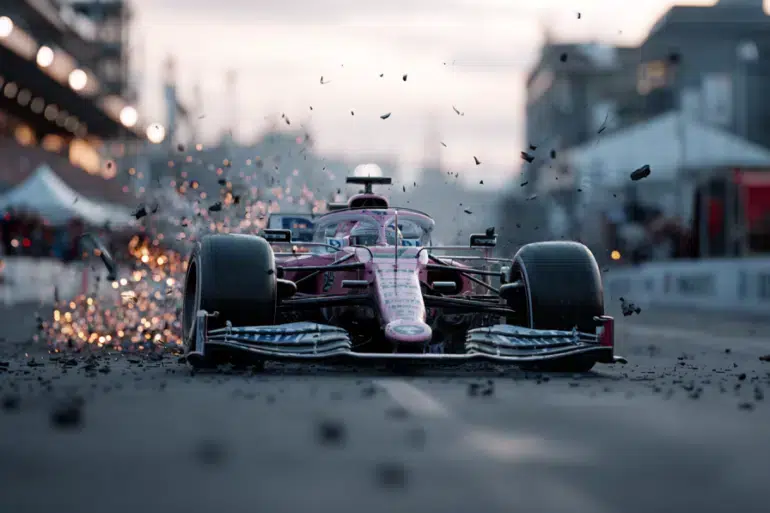


What caused Isack Hadjar’s crash at the Silverstone Grand Prix ? And what are the consequences for Formula 1 safety?
Isack Hadjar’s recent crash at Silverstone has reignited concerns about the risks of racing in heavy rain. The incident has once again put the spotlight on the dangers of iconic circuits like Spa-Francorchamps. Unpredictable weather can turn the track into a deadly trap.
Hadjar’s crash, a wake-up call at Silverstone
During the Silverstone Grand Prix, Hadjar collided with the back of Kimi Antonelli’s car in terrifying fashion. He later explained that he had “absolutely no visibility” due to the massive spray kicked up by the cars in front. Hadjar’s crash at Silverstone may have seemed minor at first glance. However, it highlighted just how unpredictable and dangerous wet-track conditions can become.

The accident sparked renewed discussions about safety when racing in the rain. Drivers pointed out that the spray generated by today’s F1 cars makes visibility nearly impossible. That is especially caused by the diffuser and the massive downforce created underneath the car. George Russell compared Hadjar’s crash during the Silverstone GP to driving on a highway at 80 mph with no windshield wipers, except at 205 mph.
Spa’s decision to put safety first
The Silverstone crash directly influenced the FIA’s decision to delay the start of the Belgian Grand Prix at Spa. Drivers like Pierre Gasly and Oscar Piastri publicly backed the cautious approach. They stressed that being overly careful is far better than putting lives at risk. They warned that avoiding another Silverstone-style crash should be a top priority.

After all, aside from Hadjar’s crash, Silverstone has a tragic history. In just six years, the circuit has claimed the lives of two drivers. Those were Anthoine Hubert in 2019 and Dilano van ’t Hoff in 2023. The memory of those accidents still haunts the paddock.
Adding to the concern, Esteban Ocon recalled a chilling moment at Spa in 2012, when he nearly collided with a stationary car hidden in the spray. His testimony echoed what many drivers now agree on: racing when you can’t see more than a few meters ahead is simply unacceptable. The FIA’s caution, they say, is not just justified. It’s also essential for keeping drivers safe.